
Software development with no black box
With clarity, method and more than 25 years of experience.
Digital projects run with clear processes, explained decisions and real follow-up, for companies that won't accept surprises, delays or costs out of control.
Find out whether this approach suits your project, with no obligation.
- A transparent process from start to delivery
- Technical decisions explained, not imposed
- A method proven over more than 25 years
- Flexibility to grow with your business
The problem isn't the code.
It's a lack of clarity in the process.
Most software projects don't fail for lack of technology. They fail for lack of clarity.
Companies don't get frustrated with development because software is complex. They get frustrated because they end up in projects where they:
- Don't know exactly what is being done
- Don't understand why certain technical decisions are made
- Get deadlines that change without explanation
- See the budget grow unpredictably
- Become dependent on the developer, with no autonomy
Over time, the project becomes a black box.
And every black box breeds uncertainty, noise and rework.
With clarity, a project stops being a risk and becomes a strategic decision.
Building software doesn't have to be a leap in the dark.
Without clarity
- Uncertainty
- Rework
- Dependency
- Delayed decisions
With clarity
- Control
- Alignment
- Continuous evolution
- Informed decisions
When the process is run with method and experience, the client can see:
What is being built at each stage
Why certain technical decisions were made
What the next steps are before they happen
Where the validation and adjustment points are
Clarity doesn't depend on goodwill. It depends on method.
Over more than 25 years of building bespoke software, systems and applications, it has become clear that successful projects follow a pattern.
That is why our development follows a method that turns technical complexity into a process that business decision-makers can understand.
Nothing is improvised. Nothing is left implicit.
Assessment and alignment
Before a single line of code, we understand the problem, the business context and the project's real objectives.
Clear definition of scope and stages
What will be built, in what order and against which validation criteria.
Development with checkpoints
The project moves forward in visible stages, with continuous follow-up and structured communication.
Constant validation
Decisions and deliveries are validated throughout the process, not just at the end.
Flexible evolution
Changes are handled deliberately, without losing control of the project.
Experience isn't just years in business.
It's a repertoire for making better decisions.
More than 25 years of building software, systems and digital solutions teaches something no framework on its own can: where projects fail, why they fail and how to prevent it before it becomes an expensive problem.
That experience is present in every scoping decision, every technical choice and every course correction along the way.
It's not about doing it faster at any cost. It's about doing it right from the start.
Clarity proves itself when it works in different scenarios.
QualityManager
A platform built for process control, standardisation and monitoring.
Inventory
A system with clear rules, traceability and a need for highly reliable data.
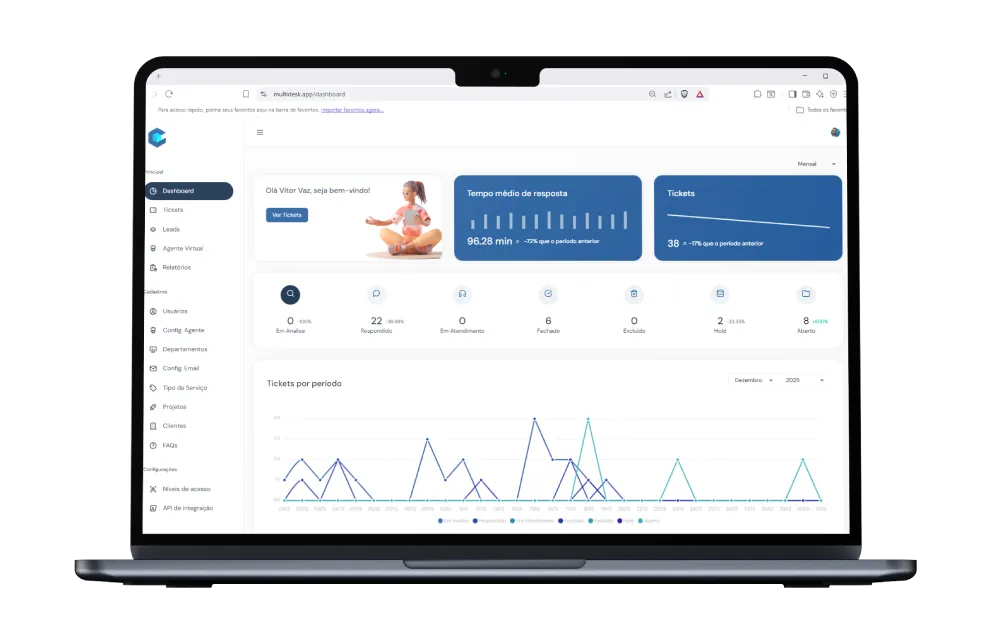
Multidesk
An environment that called for flexibility, organisation and clarity to support multiple workflows.
If you've been frustrated before, these questions are natural
Doesn't this approach make the project more expensive?
Clarity doesn't make a project more expensive. It avoids waste, rework and wrong decisions that cost far more over time. Projects without method look cheaper at the start but tend to cost more in the end.
Will I lose flexibility with such a defined process?
The method exists precisely to provide flexibility with control. Changes are possible, but they are handled deliberately, with a clear impact on time, scope and cost. Nothing is done in the dark.
What if I want to change direction mid-project?
Change is part of real projects. That is why development is run in stages with validation points, allowing adjustments without compromising the project as a whole.
How do I follow progress if I'm not technical?
You don't need to be technical. Follow-up uses plain language, objective indicators and structured communication, always linking development to business decisions.
These questions exist because you have seen projects go wrong. Our role is precisely to remove that risk with method, communication and more than 25 years of applied experience.
Ready to get your project off the ground safely?
If you already have an idea, system or digital product in mind, the next step is to validate the right way to build it, with clarity on scope, timeline and risk.